First, a note on the name change. Why PossibNow?
I’ve spent my whole life trying to find out what technology makes possible. I love gadgets. I’ll try just about every kind you can imagine. I like building stuff and finding out what I can do with my own two hands and my brain.

For a long time, I stopped short of building software. I’d convinced myself that I didn’t know how to code, so I could never build it. Even as I got further into technology companies and building technology, I still deferred to the coders.
I never picked up my so-called pen and started writing. AI changed all that for me.
It can take your ideas and make them real. To use in your life, in your work, today.
So I thought a name that reflected how AI has changed what is possible, fit an applied AI newsletter.
We are still focused on the people. Still focused on helping you succeed.
Excited to help you on that journey.
What’s Next
For me, coding is the clearest example of how AI is making what was once possible for the few accessible to the many. An idea can become a first version you can see and try. You have something concrete to react to, a way to find out whether the idea makes sense, and a starting point for making it better.
Then you iterate, iterate, iterate. You try the thing, see where it falls short, and work on the next version. Each attempt can teach you something that thinking about the idea alone could not.
Here’s the interesting thing. Even seasoned, legendary, software developers get to benefit from having AI show them what’s possible, and in the same setting, they get to prod and cajole AI into realizing it can do even more than it believed was possible.
That’s why Afam Onyimadu’s article about Linus Torvalds resonated with me.
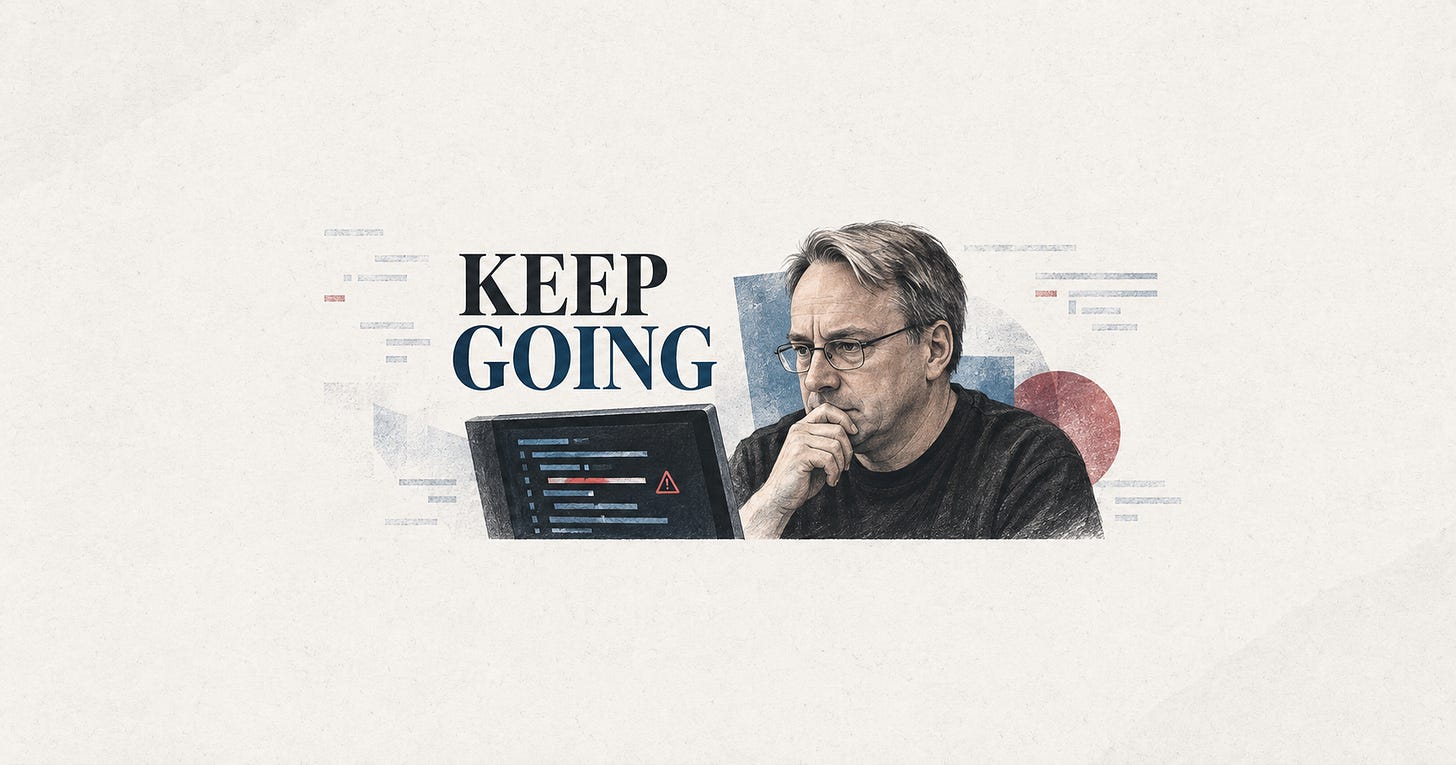
Torvalds, the creator of Linux, was tracking down a graphics-driver bug that left his computer with a black screen. The AI helped add debugging code and analyze the results. Several times, it also told him the problem was “impossible and unsolvable.” He kept directing the investigation. His experience helped him question the answer, and his persistence kept the work moving.
That combination of agency, ability, and grit tied to envisioning what is Possible is the signal you should rely. AI gave him help with difficult work. I want What AI makes PossibNow to help you attempt ideas you would previously have left in your head. You can start making something, see how it behaves, and work out what you need to learn next.
At work, that might mean figuring out a problem that has frustrated you for years or delivering a kind of work product you never thought you could produce. It could mean finding a better way to serve a client, win new business, or help your team. Those are the kinds of contributions that can help you grow revenue, keep clients, and make a case for a promotion.
At home, it might mean untangling the calendar for your kids’ activities, planning a trip with your partner, or comparing deals on something you want to buy. The same willingness to try can help you work through the ordinary frustrations you have learned to tolerate.
I think the applied loop of learning AI, using AI, and building with AI is the cheat code for the next ten years of professional life. Using a tool reveals what you need to learn next. Building something gives you a result to inspect and improve.
That’s why I enjoy working with professionals so much. I learn from them and build with them. Each week, I’ll bring you experiences from that work, along with guides and ideas you can take into your own work and life.
Thanks for reading What AI makes PossibNow! This post is public so feel free to share it.
Useful now
Build a dashboard around the question you need answered
OpenAI’s new Data agent in ChatGPT Work connects to approved business data, investigates questions, and creates interactive dashboards you can refine in conversation. It can use your organization’s definitions of terms and metrics, which matter when two teams mean different things by “revenue.”
For someone responsible for sales, operations, or a department budget, that opens a practical starting point. Describe the decision you need to make, then ask for a view that helps you make it. Access depends on the Data plugin and the relevant connections being enabled. Check the numbers against a report you already trust before using the dashboard to direct work.
Turn a useful Slack thread into knowledge your team can reuse
Claude Tag lets a team bring @Claude into a Slack channel to work from shared context and connected tools. It remembers relevant channel and workspace information, and colleagues can continue the same conversation. It is in beta for Claude Team and Enterprise, with an organization’s Primary Owner or Owner setting up access and enabled channels.
I think this is a cool hack for knowledge management. So much useful expertise shows up in a thread, gets an answer, and disappears into the scroll. You could ask Claude to turn that exchange into a draft FAQ or decision note, with links back to the discussion and unresolved questions left visible. Then have someone who knows the work check it before the team treats it as settled.
Use a management book to prepare for a difficult conversation
Google’s Expert Intelligence lets you add eligible ebooks purchased through Google Play Books to Gemini Notebook and combine them with your own sources. Google gives a useful example for managers, drawing on Kim Scott’s *Radical Candor* to work through employee feedback and tough conversations.
A book you value can become something you consult about a situation you are facing. Describe the conversation without identifying the employee, ask which ideas from the book apply, and inspect the cited passages. The feature requires an eligible purchased book; someone sharing your notebook needs their own copy to use that book’s content.
Carry your working preferences from a conversation into the work
Claude now shares memory between chat and Cowork, including cloud tasks. In Memory settings, you can view, edit, or delete saved topics. Anthropic’s examples include carrying an event’s details from an agenda discussion into a budget and keeping the team’s metric definitions available for quarterly reports.
That makes your preferences something you can maintain. A consultant could keep the structure they use for client updates; a manager could preserve how the team defines a useful status report. Inspect what has been saved before relying on it. On Team and Enterprise, administrators control availability, and each user must enable memory in their settings.
What’s possible
Give a sales team an assistant that knows its accounts
Salesforce and Anthropic announced a Claude plugin with 37 sales skills, including meeting preparation, deal health reviews, and pipeline reviews. It draws on live Salesforce context and routes actions through Salesforce’s business rules.
The professional possibility is preparation shaped by the account you are serving. A seller could investigate a stalled opportunity and bring a more informed set of questions to the next meeting. The announcement describes access for selected pilot customers, with an open beta expected in September.
Make a senior colleague’s judgment available beyond one conversation
Meta describes an internal system that combines expert knowledge, written procedures, and human review. When an expert corrects the AI, the system proposes changes to its knowledge or procedures, tests them, and brings them back for expert approval.
Think about the person your team consults whenever a supplier assessment or unusual client situation gets complicated. This suggests a way to preserve how that person reasons and improve the assistance after each correction. It is an architecture Meta built and reports on, with substantial evaluation and maintenance behind it.
Find the useful moment inside hours of recorded work
Google’s agentic video understanding lets Gemini search and inspect selected portions of a video across images, audio, and transcripts. The release describes searching long recordings, detecting brief events, and examining visual details more closely.
For a training lead or operations manager, the possibility is a tool that finds the exact demonstration someone needs inside a library of recordings. A product team could explore questions about what happens on screen during a recorded usability session. These are applications to build and test.
The bigger horizon, a proposed solution to a major mathematics problem
OpenAI reports that an internal AI system produced a solution to the Navier-Stokes Millennium Prize Problem, along with a formalization in the Lean proof system. The company describes roughly 10,000 coordinating agents in the group that found the solution, followed by a separate formalization and verification effort.
There is a lot of controversy around what OpenAI did to achieve the solution. I won’t dig into that controversy, but I do think what is happening with math is something for us to watch. The point of solving hard math problems is to learn, and then apply that knowledge to society. Spending millions of dollars to run thousands of agents and brute force an outcome for publicity probably isnt the best use of “what’s possible.” That being said, the genie is out of the bottle. Expect more “discoveries” and “novel solutions” to emerge in the coming years.
The loop this week
Choose one recurring piece of work you wish were easier to produce. Start with a department dashboard, a client briefing, or a training exercise.
Write down who will use it, what decision or action it should help with, and one example of a result you would trust. Give your AI tool material you are allowed to use and ask for a first version. Inspect it against that example. Tell the AI exactly what needs to improve, then try the next version.
Keep a short note of what worked and what you still need to learn. That gives you a starting point for the next turn through the loop.
Get the next one on Friday.
Applied AI for professionals, by Sal Carranza. One workflow a week, free.