Welcome to PossibNow. This is a place to learn what AI can help you do, try it on work that matters, and keep the methods that prove useful. This issue looks at delegation as a professional skill as we direct more work through people and agents. You’ll use the judgment you already bring to your job, apply PULL to decide where AI can help, and explore the tools and approaches that can turn a useful assignment into work you can review.
Delegation has been an incredibly important skill in corporates. As companies grew, they added managers, and often managers of managers. The skill required to manage work had less to do with work creation and more with people delegation. The best managers knew how to stay close enough to the work to apply their expert taste and yet delegate work to people they trusted to make sure work got done at scale. But how do you do that in a world of agents?
It’s certainly not by using AI like a vending machine.
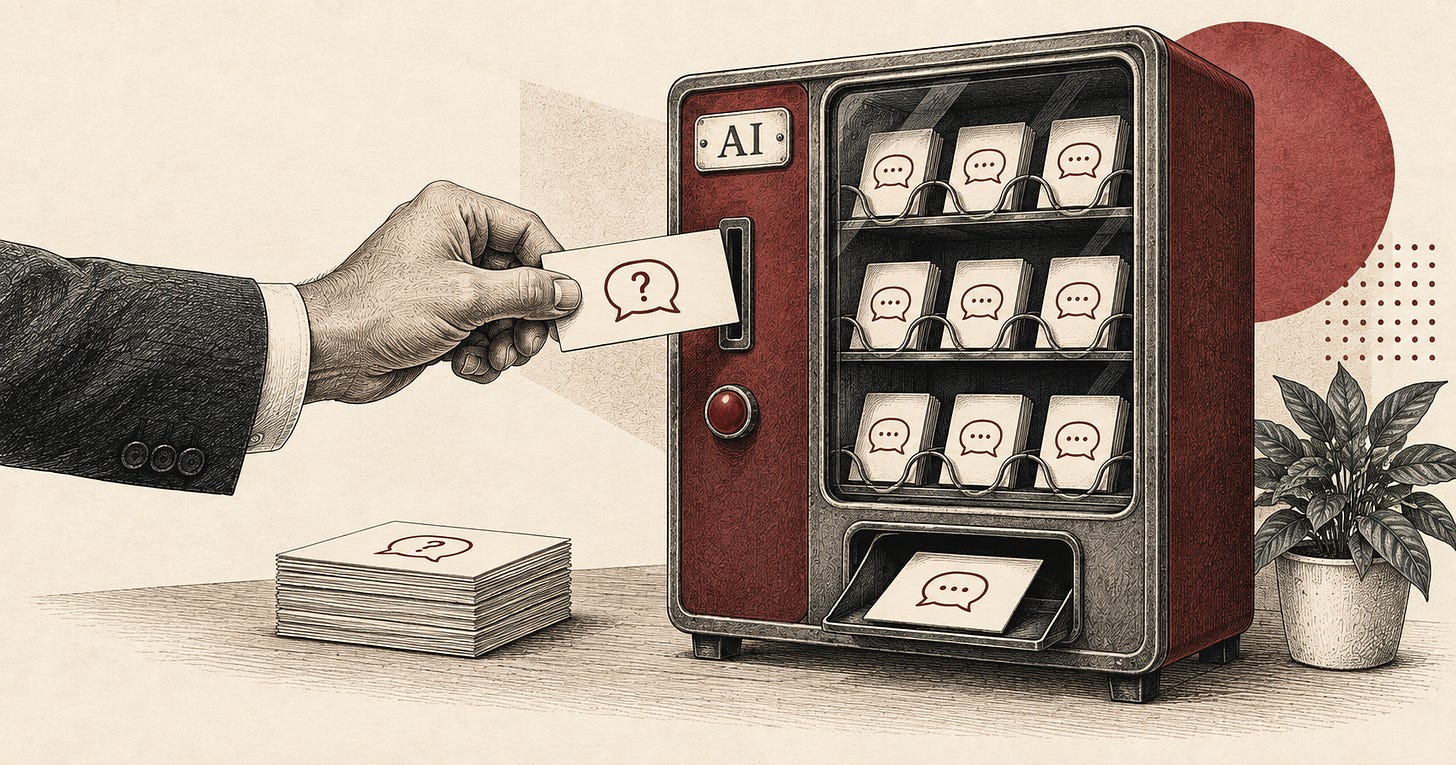
I saw a meme about someone uploading a Word document to ChatGPT to count the words. The punchline was that the observer immediately bought every AI stock they could find.
Why? Well, Word already has a word counter, but what the joke highlights is that most people are still learning to use old software. Chatbots are easy, so they drop something into a box, ask a question, get an answer. AI becomes the vending machine for whatever you need next.
So how do you decide decide what AI works on?
What’s Next
It starts with taste. My view is that choosing where AI belongs will become a very valuable professional skill. You already know what good looks like in your job. So being able to get that same great output, with AI as a tool, will be what separates talented teams. Especially because I expect professionals to direct smaller human teams alongside much larger teams of agents. Individual contributors could take responsibility for work that previously required several people, if they can define the assignments, coordinate the work, and judge the results.
Being able to direct more work makes those choices more consequential.
I recently read Rob Snyder’s The PULL Framework, In Detail, about why people buy things, and kept thinking about a different application. Could the same framework help professionals decide where to use AI?
Snyder starts with what a person needs to accomplish, why it matters now, the options they have, and the limitations of those options. I think that gives us a useful way to examine our own work before we decide what to hand over to an agent.
It also connects to something I keep saying.
The right tool for the job, at the right time, in the right place.
PULL helps us decide which assignments deserve that effort. Here is how I would apply its four parts inside a team.
-
Project. What specific result does someone need?
-
Urgent or unavoidable. Why does it deserve attention now?
-
List of options. How could they accomplish it today?
-
Limitations. What makes those options inadequate?
Consider an account team preparing for a renewal meeting. They need to understand unresolved customer concerns before the meeting. Their options include reading emails, reviewing support tickets, and asking the account owner for a summary.
If the difficulty is bringing scattered evidence together, an AI-assisted briefing may be worth testing. If the difficulty is that nobody has spoken to the customer, generating a polished briefing will not supply that missing conversation. The same exercise could reveal work the team would like to undertake but cannot currently justify the time to complete.
The Cowork change and Meta’s Muse give us timely reference points for what we might delegate. That gives us a reason to think beyond the next answer. A useful assignment might involve gathering information, comparing it, creating something, and checking it before anyone acts.
But a new way to delegate does not tell you which assignment matters.
Step one is to find a real need, then test whether AI can address the limitation. Once we know what deserves attention, we can decide which tools belong in the work and which choices to leave with the agent.
Useful now
Claude brings Cowork into ordinary conversations
Anthropic’s September 16 announcement brings Cowork and chat together and introduces Docs and Slides alongside Design in conversations. The interface for work is merging. Your job is to make sure your doing more than asking the chatbot for an answer.
Give your team a workflow it can reuse
Natalia Quintero and Mike Taylor’s August article answers executives’ questions about AI adoption. They recommend shared skills, examples, and standards, with clear owners and measurements against the existing process. After finding a useful assignment, keep its instructions and a good example together. Include review and correction time when deciding whether the new approach helps.
Make connected tools useful in daily work
Panth Bhasvar describes Theory’s experience connecting agents to the team’s documents, data, and applications. The article explains why agents need clear tool descriptions, relevant information, and a way to confirm that work finished. For professionals, it offers concrete questions to bring to an implementation team. Ask how the agent chooses its tools, retrieves current information, and verifies completion.
Match the approach to the work you are delegating
In a September 20 interview, Appian’s Gregg Aldana recommends conventional rules for predictable work and agents for tasks that require adaptive reasoning or changing information. He argues for combining people, agents, and ordinary automation within a process. For your next assignment, distinguish the steps with a known procedure from those that need interpretation. Judge the approach by whether it improves the result.
Thanks for reading What AI makes PossibNow! Subscribe for free to receive new posts and support my work.
What’s possible
Muse shows how a personal agent can keep working
Meta’s designers describe Muse’s persistent memory, its own computer, and background work that responds to schedules or events. For professionals, the interesting possibility is ongoing support for a goal, such as gathering relevant updates before a recurring meeting. This is the promise of agentic AI for work, being demonstrated in your personal life.
Let an agent turn repeated work into a workflow
Grep.ai’s Miguel Ríos Berríos describes AgentRun learning from completed runs to create a workflow that combines agents and ordinary code, while retaining an agent for unusual cases. This is a concrete expression of choosing the right tool for each step. It suggests a path from delegating one assignment to improving how repeated assignments run.
Build the checks around the work
Tomasz Tunguz describes software teams focusing on system design, constraints, and verification around agent-generated code. The application I see for other professions is designing how an assignment gets checked before repeating it. Define the expected result, the evidence needed to support it, and how to catch errors. The software examples offer a pattern to examine, rather than a forecast of another team’s productivity.
Decide when an agent should involve you
Ethan Mollick proposes a “Twilight Factory” in which agents seek human participation for approval, expertise, different perspectives, and interesting decisions. His August essay adds a useful question to workflow design. Which parts of an assignment should bring you back into the conversation? It is a proposal for organizing work, with room for professional judgment beyond approving finished outputs.
The loop this week
Practice delegation on one real assignment. Work through PULL with the person who understands it, then decide which parts need a colleague, an agent, or an existing tool.
Learn. Identify the result you need, why it matters now, and where your current options fall short.
Use. Give the agent a defined assignment, the information it needs, and a clear standard for the result. Decide which choices it can make and when it should bring you back into the conversation.
Build. Compare the completed work with your standard. Keep the instructions and review criteria that helped, and revise what caused confusion before delegating the next assignment.
As the team of people and agents you direct grows, I expect the quality of your delegation to matter more. Start with an assignment small enough to review, and use the result to decide how much more work to hand over.
Thanks for reading What AI makes PossibNow! Subscribe for free to receive new posts and support my work.
Get the next one on Friday.
Applied AI for professionals, by Sal Carranza. One workflow a week, free.